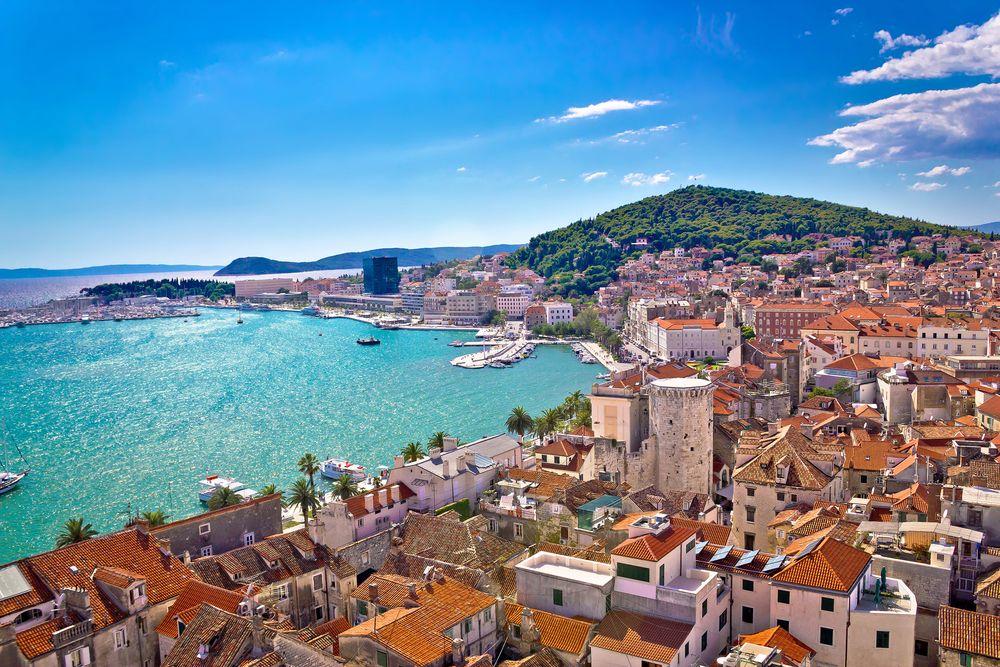
About Croatia
Croatia is an Eastern European country with a long coastline on the Adriatic Sea. Encompassing more than a thousand islands, it's also crossed by the Dinaric Alps. Its inland capital, Zagreb, is distinguished by its medieval Gornji Grad (Upper Town) and diverse museums. The major coastal city Dubrovnik has massive 16th-century walls encircling an Old Town with Gothic and Renaissance buildings. The Croats arrived in the area of present-day Croatia during the early part of the 7th century AD. They organised the state into two duchies by the 9th century. Tomislav became the first king by 925, elevating Croatia to the status of a kingdom. Most of Croatia has a moderately warm and rainy continental climate. Mean monthly temperature ranges between −3 °C (27 °F) (in January) and 18 °C (64 °F) (in July). Tourism is a significant source of revenue during the summer. The bulk of the tourist industry is concentrated along the Adriatic Sea coast. Opatija was the first holiday resort since the middle of the 19th century. By the 1890s, it became one of the most significant European health resorts. Later a number of resorts sprang up along the coast and islands, offering services ranging from mass tourism to catering and various niche markets, the most significant being nautical tourism, as there are numerous marinas with more than 16 thousand berths, cultural tourism relying on appeal of medieval coastal cities and numerous cultural events taking place during the summer. Inland areas offer mountain resorts, agrotourism and spas. Zagreb is also a significant tourist destination, rivalling major coastal cities and resorts.
Jewish History, POI & Kosher Establishments in Croatia
Three quarters of Croatia's 2,000 Jews live in the capital of Zagreb. There are small communities in Osijek, Rijeka, Split, and Dubrovnik. Although intermarriage has been widespread, most offspring of such unions have a strong sense of Jewish identity. Jews arrived in Croatia with the Roman armies, and there are remains of a Jewish cemetery in Solin (near Split) dating back to the 3rd century. That community ceased to exist in 641, when Solin was destroyed. Jews lived in Zagreb in the 13th and 14th centuries. However, Jews were expelled from Croatia proper and from Slavonia in 1456 and did not return until the end of the 18th century, by which time the territory was ruled by the Hapsburgs. After World War I, upon the establishment of an independent Yugoslavia incorporating Croatia some 20,000 Jews lived in Croatia. After the 2nd World War, some of the survivors returned; the Jewish community was reconstituted and Jewish life resumed. The Federation of Jewish Communities is responsible for Jewish religious and cultural life in Croatia. The Community building in Zagreb contains a synagogue, an art gallery, a Holocaust research and documentation centre and a Jewish library named after Rabbi Lavoslav Sik of Zagreb, who perished in Auschwitz. There are no kosher restaurants in Croatia but the Bet Israel Community annually publishes a list of available kosher products.
Check out our blog post
The Croatian Chronicles: Journey through Time and Beauty to help you plan your kosher vacation to Croatia.