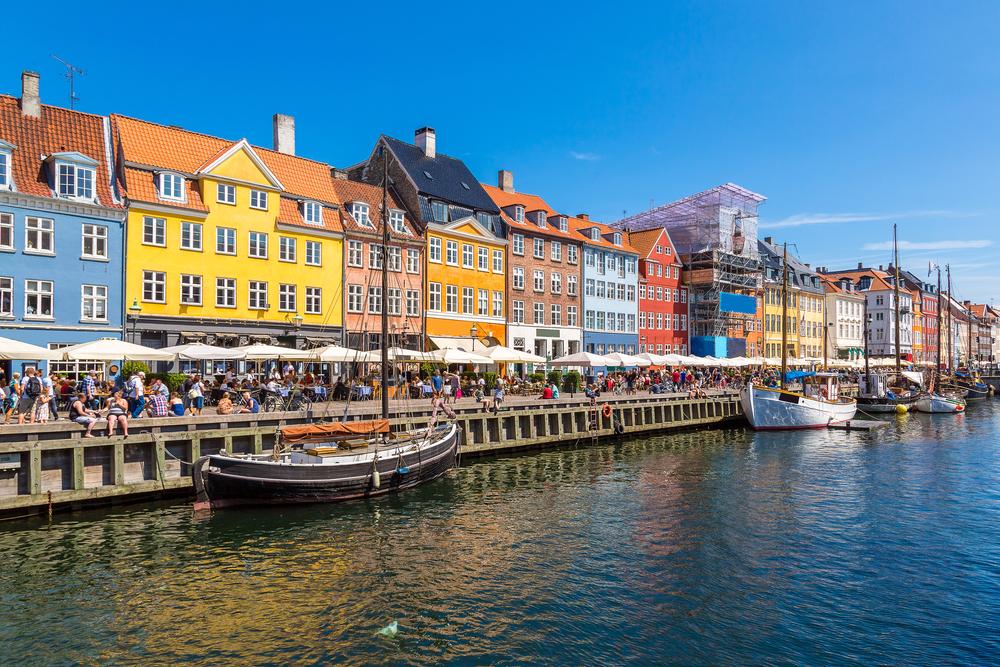
About Denmark
Denmark, officially the Kingdom of Denmark, is a Scandinavian country in Europe and a sovereign state. The southernmost and smallest of the Nordic countries, it is south-west of Sweden and south of Norway, and bordered to the south by Germany. The country consists of a peninsula, Jutland, and an archipelago of 443 named islands, with the largest being Zealand and Funen. The islands are characterised by flat, arable land and sandy coasts, low elevation and a temperate climate. The Kingdom of Denmark also comprises two autonomous constituent countries in the North Atlantic Ocean: the Faroe Islands and Greenland. The unified kingdom of Denmark emerged in the 10th century as a proficient seafaring nation in the struggle for control of the Baltic Sea. Denmark has long stretches of sandy beaches, attracting many tourists in the summer, with Germany accounting for most foreign visitors. Swedish and Norwegian tourists often come to visit the relatively lively city of Copenhagen, while many young Scandinavians come for Denmark's comparably cheap and readily accessible beer, wines and spirits. As Europe's oldest kingdom and the home of Hans Christian Andersen, Denmark is often marketed as a "fairytale country". Among the major tourist attractions are Tivoli Gardens, the Freetown Christiania and The Little Mermaid, all located in Copenhagen. Kronborg Castle in Helsingør is famous for its associations with Shakespeare's Hamlet. The Louisiana Museum of Modern Art 30 km north of Copenhagen is the most visited museum in Denmark, and Roskilde Festival near Roskilde 30 km west of Copenhagen attracts over 100,000 guests every year.
Jewish History, POI & Kosher Establishments in Denmark
Denmark was the first Scandinavian country to permit Jewish settlement (Jews were prohibited entry into Denmark after the Reformation in 1536). In 1622, King Christian IV invited Spanish and Portuguese Jews from Amsterdam and Hamburg to settle in Gluckstadt on the Elbe estuary (then in Denmark). While these Jews were granted economic and religious freedom, Ashkenazim from Germany were subject to many restrictions. In 1684, the unified Jewish community of Copenhagen was established by ordinance of King Christian V. Civic equality was eventually granted to Jews in 1814, and by 1849 they had attained full citizenship. Although Denmark was occupied by Germany in April 1940, the Danish monarch and the Danish government remained in the country and the Jews generally lived unmolested. In 1943, with a German roundup of Jews imminent, about 90 percent of the Jewish population was spirited to safety in neutral Sweden. All in all, 5,191 Jews, 1,301 people of part-Jewish parentage, and 686 Christians married to Jews were rescued. Four hundred and sixty-four Jews were rounded up and deported to Theresienstadt, and 49 perished there. After the war, the Jewish community was reconstituted. In 1968, 2,500 refugees from Poland, victims of a Communist Party witch-hunt, settled in the Copenhagen area. Today, the Jewish community of Denmark is the second largest in Scandinavia (after Sweden). Kosher food is readily available, and Denmark exports kosher meat to Sweden and Norway where shechita is not permitted. There are three synagogues in Copenhagen. The Great Synagogue, completed in 1833, is the seat of the rabbinate. It was designed by Gustav Friedrich Hecht, who was inspired by the architectural style of ancient Greece. It is also one of the few synagogues of its period to incorporate Egyptian elements in the columns, ceiling and cornice over the ark.