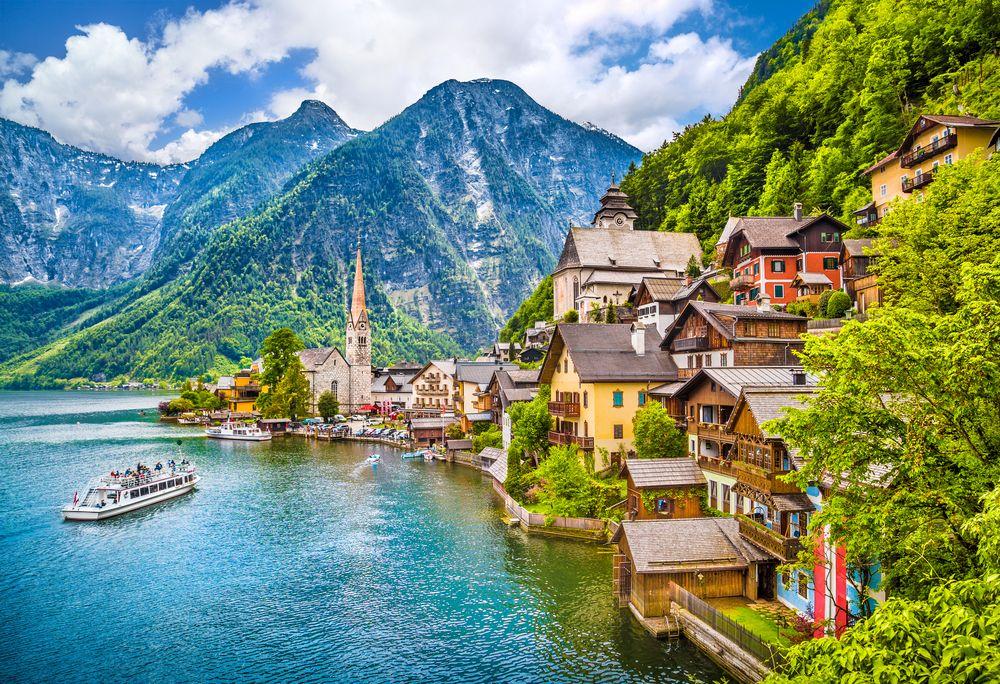
About Austria
Austria is a German-speaking country in Central Europe, characterized by its mountain villages, baroque city architecture, Imperial history and rugged alpine terrain. Vienna, its Danube River capital, is home to the Schonbrunn and Hofburg palaces, and has counted Mozart, Strauss and Sigmund Freud among its residents. The country’s other notable regions include the northern Bohemian Forest, Lake Traun and eastern hillside vineyards. The origins of modern-day Austria date back to the time of the Habsburg dynasty when the vast majority of the country was a part of the Holy Roman Empire. Today, Austria is a parliamentary representative democracy comprising nine federal states. The capital and largest city, with a population exceeding 1.7 million, is Vienna. Austria is one of the richest countries in the world. Although Austria is cold in the winter (−10 – 0 °C), summer temperatures can be relatively high,[74] with average temperatures in the mid-20s and a highest temperature of 40.5 °C (105 °F) in August 2013. Tourism accounts for almost 9% of the Austrian gross domestic product.
Jewish History, POI & Kosher Establishments in Austria
The history of the Jews in Austria probably begins with an exodus of Jews from Judea under Roman occupation. Over the course of many centuries, the political status of the community rose and fell many times: during certain periods, the Jewish community prospered and enjoyed political equality, and during other periods it suffered pogroms, deportations, and antisemitism. The Holocaust drastically reduced the Jewish community in Austria and only 8,140 Jews remained in Austria according to the 2001 census. Jews have been in Austria since at least the 3rd century AD. In 2008 a team of archeologists discovered a third-century CE amulet in the form of a gold scroll with the words of the Jewish prayer Shema Yisrael (Hear, O Israel! The Lord is our God, the Lord is one) inscribed on it in the grave of a Jewish infant in Halbturn. After the Holocaust the Jewish community in Austria was rebuilt, although it was much smaller. In the 1950s an immigration wave from the Soviet Union moved to Austria. After the fall of the Iron Curtain, there has been a renewed influx of Jewish people from the former Soviet Union. The current Austrian Jewish population is around 12,000–15,000—most of them living in Vienna, Graz, and Salzburg. About 800 of them are Holocaust survivors who lived in Austria before 1938 and about 1500 of them are immigrants from countries from the former Soviet Union.