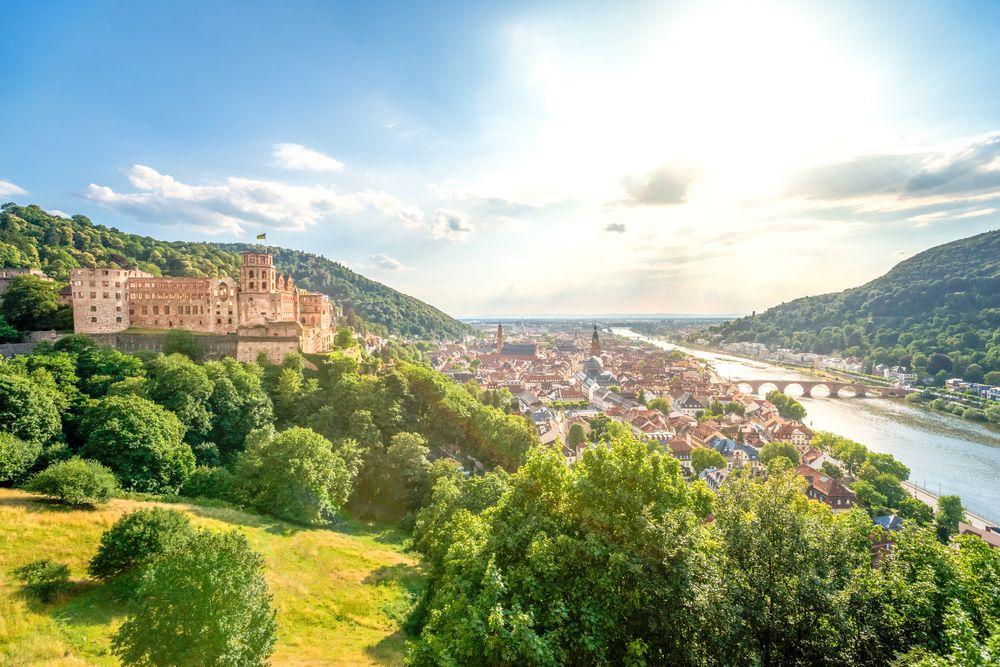
About Heidelberg
Heidelberg is a town on the Neckar River in southwestern Germany, known for its distinguished 14th-century university. Built, destroyed and partially restored over several centuries, red-sandstone Heidelberg Castle stands beside the river on Königstuhl hill. Visitors can ride the Bergbahn funicular to reach the castle and its gardens, which have sweeping views over the river and the baroque Altstadt (Old Town). The warmest month in Heidleberg is in July, the coldest in January. Temperatures often rise beyond 30 °C (86 °F) in midsummer. In the 5th century BCE, a Celtic fortress of refuge and place of worship were built on the Heiligenberg, or "Mountain of Saints". Both places can still be identified. Modern Heidelberg can trace its beginnings to the fifth century. The village Bergheim ("Mountain Home") is first mentioned for that period in documents dated to 769 AD. Bergheim now lies in the middle of modern Heidelberg. Among the most prominent museums of Heidelberg is the Carl Bosch Museum which shows life and work of chemist and Nobel Prize-winner Carl Bosch. In 2011, over 149,000 people lived in the city.
Jewish History, POI & Kosher Establishments in Heidelberg
There is little left of the original Jewish presence in Heidelberg, but a new synagogue has a committed congregation. Central Archives for Research on the History of the Jews in Germany was founded in 1987 and offers the Jewish communities an opportunity to store old records and documents. Although little is left of the pre-1945 community documents, there are collections of family papers going back to 1850 plus photographs of headstones in Jewish cemeteries. Synagogenplatz is a memorial based on a synagogue that was burnt down during the infamous Kristallnacht in 1938. It follows the original layout of the synagogue (built in 1877). Paving stones indicate the walls and twelve stone cubes show the location of the pews and stand for the twelve tribes of Israel. It's a serene and calm spot and people sometimes sit there as much for the quiet as for the remembrance. It is located on the corner of Lauerstrasse and Grosse Mantelgasse. The Jewish community numbered 188 in 1989 and 550 in 2005. The membership increased due to the immigration of Jews from the former Soviet Union. A new community center was opened in 1994.