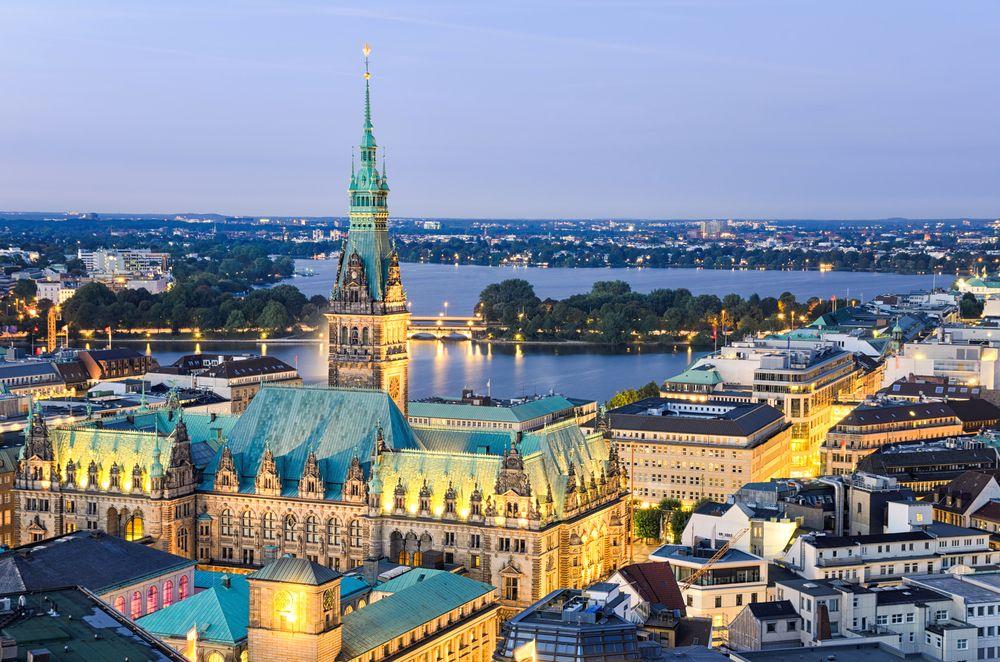
About Hamburg
One of the most important harbours in Europe and the world, Hamburg takes great pride in its mercantile background, which built the city's wealth in the past centuries. From 1241 on, it was member of the Hanseatic League, a medieval trade monopoly across Northern Europe. In the 19th and beginning of the 20th century, millions left Europe on their way to the new world through the Hamburg harbour. Today, the harbour ranks second in Europe and eleventh world-wide. Consequently, one of Hamburg's tag lines is "The Gateway to the World". There are a number of small beaches on the North side of the Elbe river between Övelgönne and Blankenese. Even though not common, it is safe to swim in the Elbe there (if you don't swim out too far). You may have a barbecue there in the evenings, as long as you bring a grill and clean up after yourself. Hamburg publishes a thick, detailed booklet of local museums called "Museumswelt Hamburg". You can find the Museumswelt Hamburg at the information desk at any of the museums. Hamburg also has a busy night-life, many art galleries, theatres and places to listen to live music.
Jewish History, POI & Kosher Establishments in Hamburg
The history of the Jews in Hamburg in Germany, is recorded from at least 1590 on. The Jews of Hamburg have lived primarily in the Jewish neighbourhoods of Grindel (de) and New Town, where the Sephardic Community „Newe Salom“ was established in 1652. From 1600 onwards, also German Jews settled in Hamburg, but in 1649 these Ashkenazi Jews were driven out of the city. From then on, only Sephardi Jews were permitted to live in Hamburg.
Around 1925, about 20,000 Jews lived in Hamburg. When the Nazis came to power, most synagogues were destroyed and soon the associated communities also were dissolved. In 1945, a Jewish community was founded by survivors of the Shoah. And finally in 1960 the new Synagogue "Hohe Weide" was built. Approximately 6,500 Jews lived in Hamburg in 1800. Thus, they represented a share of six percent of the city's total population. This was the largest Jewish community in Germany. As a result of the immigration of Jews from the former Soviet Union, the number of community members rose from 1,344 in 1989 to 5,019 in 2003. Hamburg is the only major German city who has elected a Jewish mayor since 1933. Kosher lunches can be obtained from the Jewish Congegration at Grindelhof 30. Other food can be found in other places. There is a Chabad House in Hamburg.