About Colombia
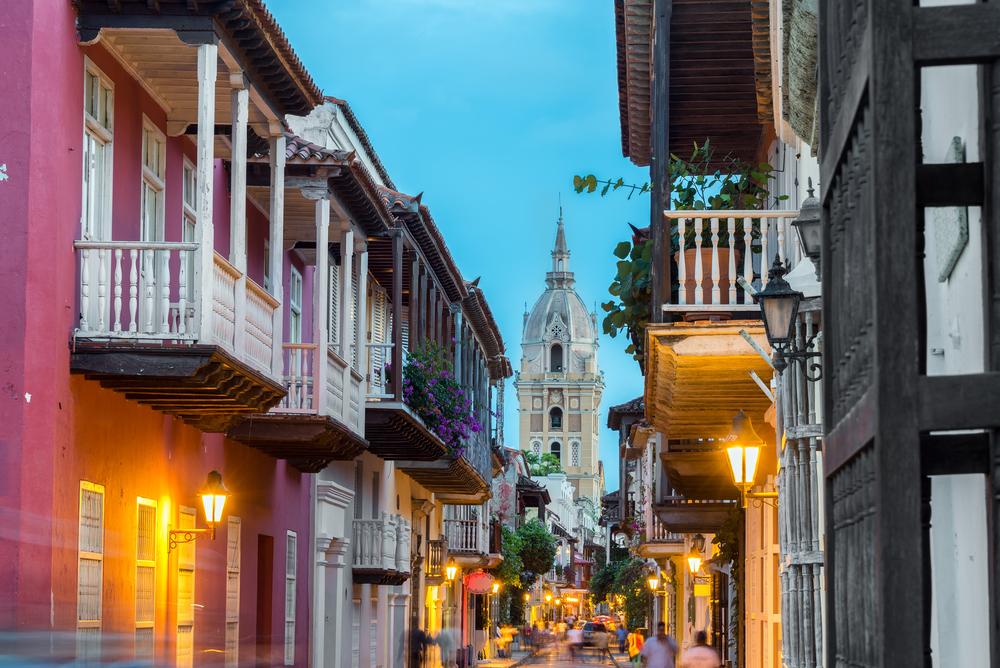
Colombia is a country at the northern tip of South America. Its landscape is marked by rainforests, Andes Mountains and numerous coffee plantations. In the high-altitude capital, Bogotá, the Zona Rosa district is known for its restaurants and shops. Cartagena, on the Caribbean coast, has a walled colonial Old Town, a 16th-century castle and nearby coral reefs. The territory of what is now Colombia was originally inhabited by indigenous peoples including the Muisca, the Quimbaya and the Tairona. The Spanish arrived in 1499 and initiated a period of conquest and colonization ultimately creating the Viceroyalty of New Granada, with its capital at Bogotá. Independence from Spain was won in 1819, but by 1830 the "Gran Colombia" Federation was dissolved. Colombian territory also encompasses Amazon rainforest, tropical grassland and both Caribbean and Pacific coastlines. Ecologically, it is one of the world's 17 megadiverse countries, and the most densely biodiverse of these per square kilometer. The climate of Colombia is characterized for being tropical presenting variations within six natural regions and depending on the altitude, temperature, humidity, winds and rainfall. Colombia has major attractions as a tourist destination, such as Cartagena and its historic surroundings, which are on the UNESCO World Heritage List; the insular department of San Andrés, Providencia y Santa Catalina; and Santa Marta and the surrounding area. The coffee region is also a very popular destination, especially the city of Armenia and its surroundings. Fairly recently, Bogotá, the nation's capital, has become Colombia's major tourist destination because of its improved museums and entertainment facilities and its major urban renovations, including the rehabilitation of public areas, the development of parks, and the creation of an extensive network of cycling routes.
Jewish History, POI & Kosher Establishments in Colombia
The first Jews came to Colombia during the 16th century. They came as settlers from Spain who practiced Christianity but were really Marranos. In 1636, a huge group of Marranos were caught and put to death. There was still a small group of secret Jews after this massacre, but they slowly diminished. There are no practicing Jews left from this time period in Colombia. The first wave of practicing Jews came from Jamaica and Curacao. These Jews started practicing their religion openly at the end of the 18th century, even though it was not officially legal to do so. Once Judaism was made a legal religion, the government granted the Jews a plot of land for a cemetery. Most Jews in Colombia are not observant and generally not active in religious Jewish life. Emphasis is on social gatherings and only a handful of Jews keep kosher. The Jews in Colombia are concentrated in a few professions. Most of the Jews in Colombia are concentrated in Bogota. There are small communities in Cali, Barranquilla and Medellin. The size of the Ashkenazi and Sephardi population is about the same. There are nine synagogues throughout the country. Due to the unstable economy and violence against Jews, many Jews have left Colombia. In the mid-1990s the population was 5,650 and, in the early twenty-first century, the Jewish population has decreased to 4,200. Most of the Jews that have left have gone to settle in Miami and other parts of the United States.