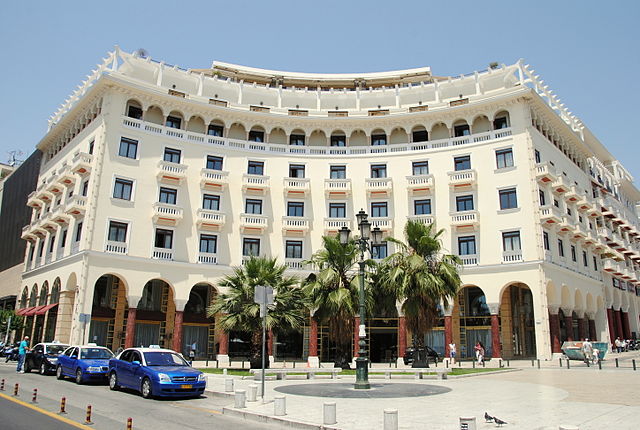
About Thessaloniki
Thessaloniki is the second-largest city in Greece, with over 1 million inhabitants in its metropolitan area, and the capital of Macedonia. The city of Thessaloniki was founded in 315 BC by Cassander of Macedon. An important metropolis by the Roman period, Thessaloniki was the second largest and wealthiest city of the Byzantine Empire. It was conquered by the Ottomans in 1430, and passed from the Ottoman Empire to Greece on 8 November 1912. Thessaloniki is a popular tourist destination in Greece. In 2013, National Geographic Magazine included Thessaloniki in its top tourist destinations worldwide. After the 2nd World War Thessaloniki was rebuilt with large-scale development of new infrastructure and industry throughout the 1950s, 1960s and 1970s. Many of its architectural treasures still remain, adding value to the city as a tourist destination, while several early Christian and Byzantine monuments of Thessaloniki were added to the UNESCO World Heritage list in 1988. The climate is mainly Mediterranean but because there is a small amount of rain in the summer it doesn't qualify as such, but in general winters are cool and wet and summers are hot and dry.
Jewish History, POI & Kosher Establishments in Thessaloniki
The Jewish population in Greece is the oldest in mainland Europe (see Romaniotes). When Paul the Apostle came in Thessaloniki he taught in the area of what today is called Upper City. Later, during the Ottoman period, with the coming of Sephardic Jews from Spain, the community of Thessaloniki became mostly Sephardic. Thessaloniki became the largest center in Europe of the Sephardic Jews, who nicknamed the city la madre de Israel (Israel's mother) and "Jerusalem of the Balkans". It also included the historically significant and ancient Greek-speaking Romaniote community. During the Ottoman era, Thessaloniki's Sephardic community of was half the population according to the Ottoman Census of 1902 and almost 40% the city's population of 157,000 about 1913; Jewish merchants were prominent in commerce until the ethnic Greek population increased after independence in 1912. By the 1680s, about 300 families of Sephardic Jews, followers of Sabbatai Zevi, had converted to Islam, becoming a sect known as the Dönmeh (convert), and migrated to Salonika, whose population was majority Jewish. They established an active community that thrived for about 250 years. Many of their descendants later became prominent in trade. Many Jewish inhabitants of Thessaloniki spoke Ladino, the Romance language of the Sephardic Jews. In 1943 the Nazis began brutal, inhumane actions against the historic Jewish population in Thessaloniki, forcing them into a ghetto near the railroad lines and beginning deportation to concentration and labor camps where they dehumanised their captives. They deported and exterminated approximately 96% of Thessaloniki's Jews of all ages during the Holocaust. The Thessaloniki Holocaust memorial in Eleftherias ("Freedom") Square was built in 1997 in memory of all the Jewish people from Thessaloniki, who died in the Holocaust. The site was chosen because it was the place where Jewish residents were rounded up before embarking to trains for concentration camps. Today, a community of around 1200 remains in the city.