About Uruguay
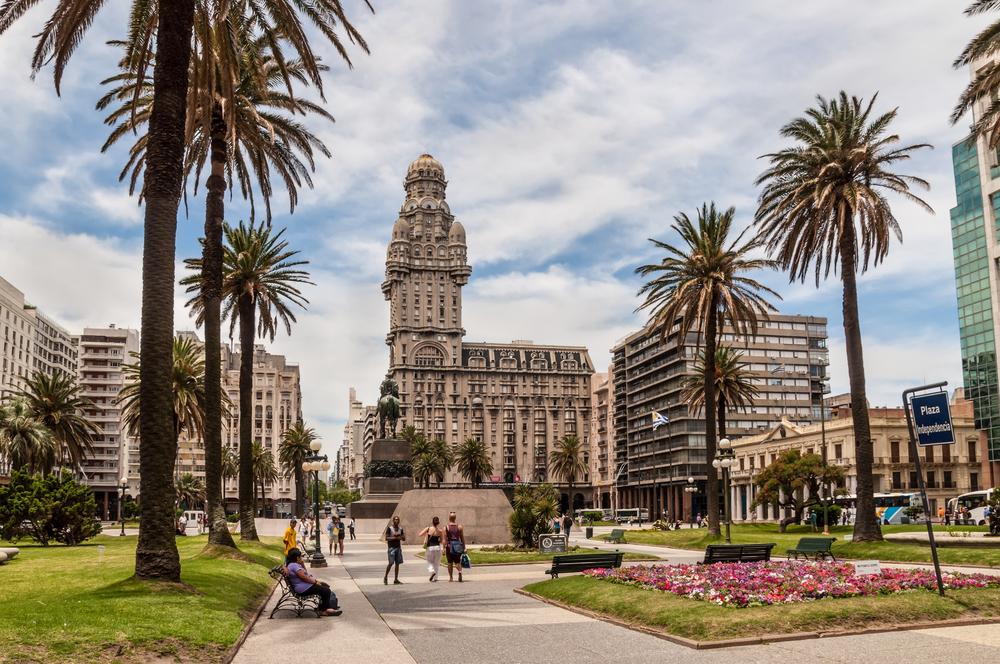
Uruguay is a South American country known for its verdant interior and beach-lined coast. The capital, Montevideo, revolves around Plaza Independencia, once home to a Spanish citadel. It leads to Ciudad Vieja (Old City), with art deco buildings, colonial homes and Mercado del Puerto, an old port market with many steakhouses. La Rambla, a waterfront promenade, passes fish stalls, piers and parks. Uruguay is home to an estimated 3.42 million people, of whom 1.8 million live in the metropolitan area of its capital and largest city, Montevideo. Uruguay was inhabited by the Charrúa people for approximately 4000 years before the Portuguese established Colonia del Sacramento, one of the oldest European settlements in the region, in 1680. Located entirely within a temperate zone, Uruguay has a climate that is relatively mild and fairly uniform nationwide. Nearly 95% of Uruguay's electricity comes from renewable energy. The dramatic shift, taking less than ten years and without government funding, lowered electricity costs and slashed the country's carbon footprint. Most of the electricity comes from hydroelectric facilities and wind parks. Uruguay no longer imports electricity. Montevideo, the country's capital, houses the most diverse selection of cultural activities. Historical monuments such as Torres Garcia Museum as well as Estadio Centenario, which housed the first world cup in history, are only a couple samples of the culture depth that tourists commonly seek. However simply walking the streets allows one to experience the colorful blend of culture the city has to offer. One of the main natural attractions in Uruguay is Punta del Este. Punta del Este is a prominent tourist destination on a small peninsula off the southeast shore of Uruguay. Its beaches are divided into Mansa, or meek, (river side) and Brava, or brave, (ocean side). These beaches offer versatility to the tourist experience, the Mansa being more ideal for sunbathing, snorkeling, & other low-key recreational opportunities, and the Brava being more ideal for adventurous water sport enthusiasts. Punta del Este is virtually connected to the city of Maldonado and eastward spread widely, encompassing La Barra and José Ignacio. It has 122 hotels, 80 restaurants, an international airport and a yacht port that can accommodate 500 boats.
Jewish History, POI & Kosher Establishments in Uruguay
The history of Uruguay's Jewish community parallels that of the country, which has been a geographic buffer between Argentina and Brazil. Uruguay did not have an active Inquisition and there are some traces of Conversos who lived in the 16th century. Today's Jewish community dates back to 1880. For many Jews Uruguay was a temporary station on their way to Argentina or Brazil. In 1909 there were 150 Jews living in Montevideo. By 1916 there were enough Ashkenazi Jews to form a chevra kadisha, and in 1917 to open the first synagogue. In 1918 there were some 1,700 Jews in Uruguay, 75% of them Sephardim (from the Balkans, Syria, Cyprus, Morocco, Egypt, Greece, Turkey and France) and the rest from Eastern Europe (mostly from Russia, Poland and Lithuania). The Jewish community of Uruguay is made up of some 10,000 families, organized into four separate religious communities-Polish-Russian, Sephardi, German, and Hungarian. The 60 Jewish organizations in Uruguay are all under the auspices of the Israelite Central Committee. There are 14 Orthodox synagogues in Uruguay and a Conservative one (the German community). Two Orthodox rabbis and two Conservative rabbis cater to the needs of the religious communities. The Chabad Centre, which has its own rabbi, is not affiliated with the community organization. Kosher food, both locally produced and imported, is readily available. There are several kosher restaurants, mainly in Jewish institutions. Montevideo has a Jewish museum and documentation centre, as well as a Holocaust memorial museum which has been declared an historic national landmark. A monument to Golda Meir stands in the square named for the late Israeli leader, adjacent to the opera house Teatro Solis. In Rodo Park by the seaside stands the Albert Einstein Monument. Within the Jewish cemetery there are monuments in memory of the victims of the Shoah, Israeli soldiers who fell in battle, and victims of the terrorist attack on the AMIA building in Buenos Aires. The old Jewish neighbourhood of Goes contains traces of its Jewish past.