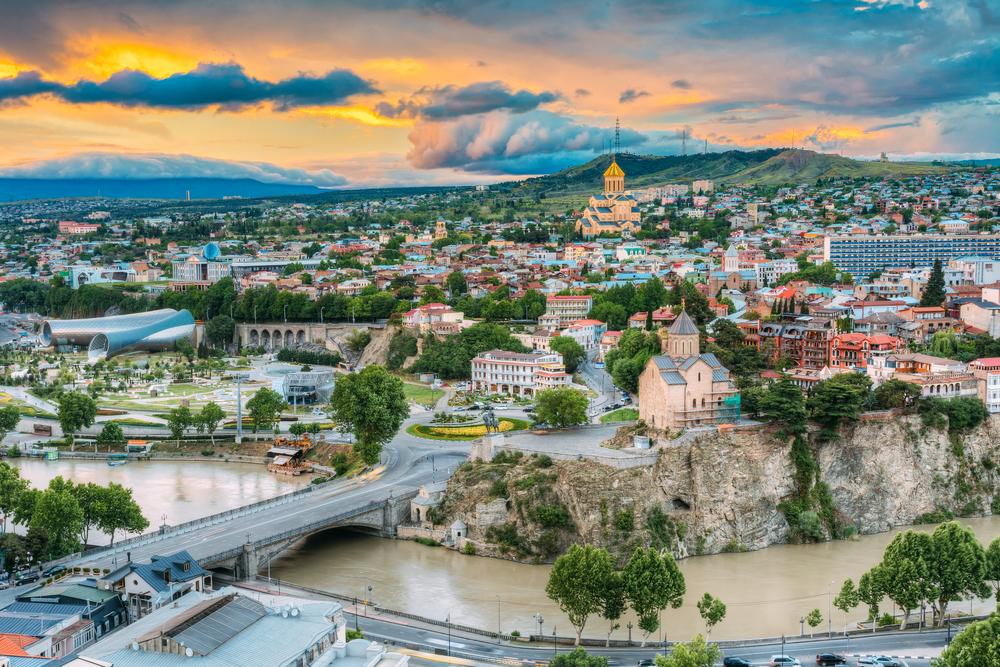
About Georgia
Georgia, a country at the intersection of Europe and Asia, is a former Soviet republic that’s home to Caucasus Mountain villages and Black Sea beaches. It’s famous for Vardzia, a sprawling cave monastery dating to the 12th century, and the ancient wine-growing region Kakheti. The capital, Tbilisi, is known for the diverse architecture and mazelike, cobblestone streets of its old town. After the fall of the Soviet Union, Georgia declared her independence in 1991, and became a Commonwealth of Independent States (CIS) republic. Since independence, the country has faced continuous military conflict, leaving the region in political and economic turmoil. The climate of Georgia is extremely diverse, considering the nation's small size. There are two main climatic zones, roughly corresponding to the eastern and western parts of the country. The Greater Caucasus Mountain Range plays an important role in moderating Georgia's climate and protects the nation from the penetration of colder air masses from the north. The Lesser Caucasus Mountains partially protect the region from the influence of dry and hot air masses from the south. Tourism is an increasingly significant part of the Georgian economy. In 2016, 2,714,773 tourists brought approximately US$2.16 billion to the country. According to the government, there are 103 resorts in different climatic zones in Georgia. Tourist attractions include more than 2,000 mineral springs, over 12,000 historical and cultural monuments, four of which are recognised as UNESCO World Heritage Sites (Bagrati Cathedral in Kutaisi and Gelati Monastery, historical monuments of Mtskheta, and Upper Svaneti).
Jewish History, POI & Kosher Establishments in Georgia
The Jews of Georgia are divided into two groups. Georgian Jews have a 2,600-year history in the region, while the Ashkenazim came to the country during the Russian annexation in the early 19th century. Today, there are approximately 3,000 Jews living in Georgia. The Jewish population of Georgia has steadily decreased over the years due to aliyah in response to the political and economic issues since independence. There are three synagogues in Tiblisi a Hilel office and The Jewish Agency who mainly look after the large ageing Jewish population (over 50% of the Jewish community is elderly). There is also an Israeli consulate which is making links in Agriculture, Start-ups, Real estate and Tourism between the two countries. Israel has also helped Georgia out with drought and earthquake disasters.