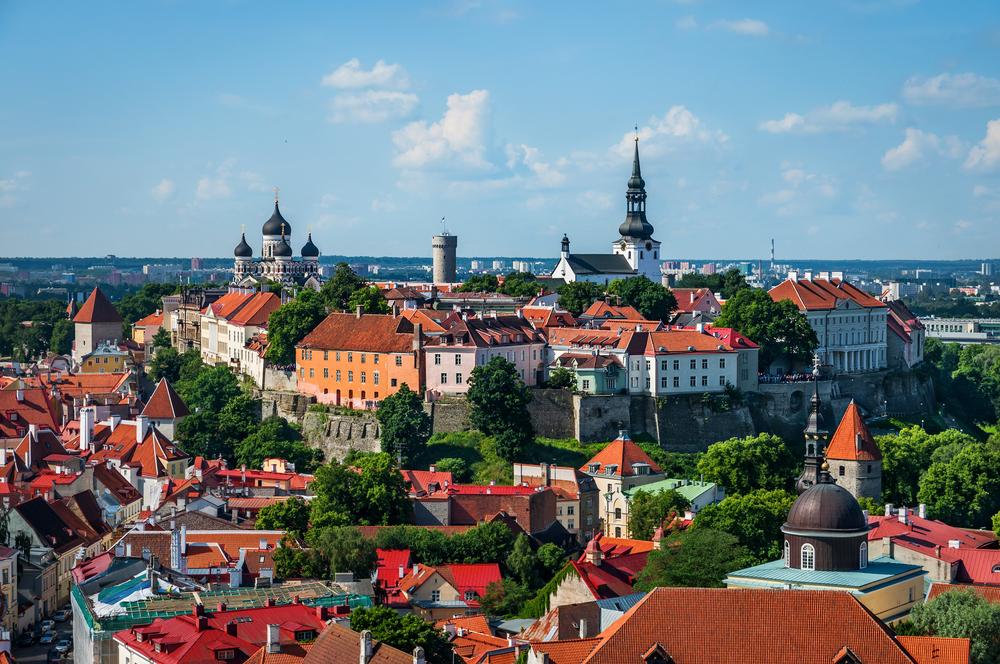
About Estonia
Estonia, a country in Northern Europe, borders the Baltic Sea and Gulf of Finland. Including more than 1,500 islands, its diverse terrain spans rocky beaches, old-growth forest and many lakes. Formerly part of the Soviet Union, it's dotted with castles, churches and hilltop fortresses. The capital, Tallinn, is known for its preserved Old Town, museums and the 314m-high Tallinn TV Tower, which has an observation deck. Estonia lies on the eastern shores of the Baltic Sea immediately across the Gulf of Finland from Finland on the level northwestern part of the rising East European platform between 57.3° and 59.5° N and 21.5° and 28.1° E. Average elevation reaches only 50 metres (164 ft) and the country's highest point is the Suur Munamägi in the southeast at 318 metres (1,043 ft). There is 3,794 kilometres (2,357 mi) of coastline marked by numerous bays, straits, and inlets. Tallinn is the biggest centre for tourists in Estonia. The historic Old Town with its numerous sights is one of the most impressive medieval monuments in Europe. The rest of the country is much quieter, though. Indeed, cities like Pärnu, Tartu or the small town Otepää, which is famous for being a winter sports resort, are starting to become internationally renowned. Estonia presents itself as an attractive mixture of a few metropolitan cities and numerous beautiful landscapes.
Jewish History, POI & Kosher Establishments in Estonia
Today approximately 2,500 Jews live in Estonia, most of them in Tallinn. Outside of the capital, small communities exist in Kohtla-Jarv, Parnu, Tartu and Narva. The first Jews arrived in what is now Estonia as early as 1333. In the 17th century, the number of Jews in the region increased, as evidenced by the fact that the authorities introduced an oath of loyalty especially for the Jews. From its beginnings as an independent state (1917–1940), Estonia demonstrated tolerance toward all religious minorities. In 1926, Jews were granted cultural autonomy that was guaranteed by law. In the first elections to the Council of Cultural Autonomy, 1464 Jews, i.e., 71% of those with Estonian citizenship, participated. There is only one functioning synagogue in Estonia. Also known as Beit Bella, the ultra-modern glass and concrete building was consecrated in 2007 and can seat 180 worshippers with additional seating for up to 230 people for concerts and other public events. The synagogue is presided over by a resident Chabad rabbi. There is a kosher restaurant adjacent to the synagogue Beit Bella.